
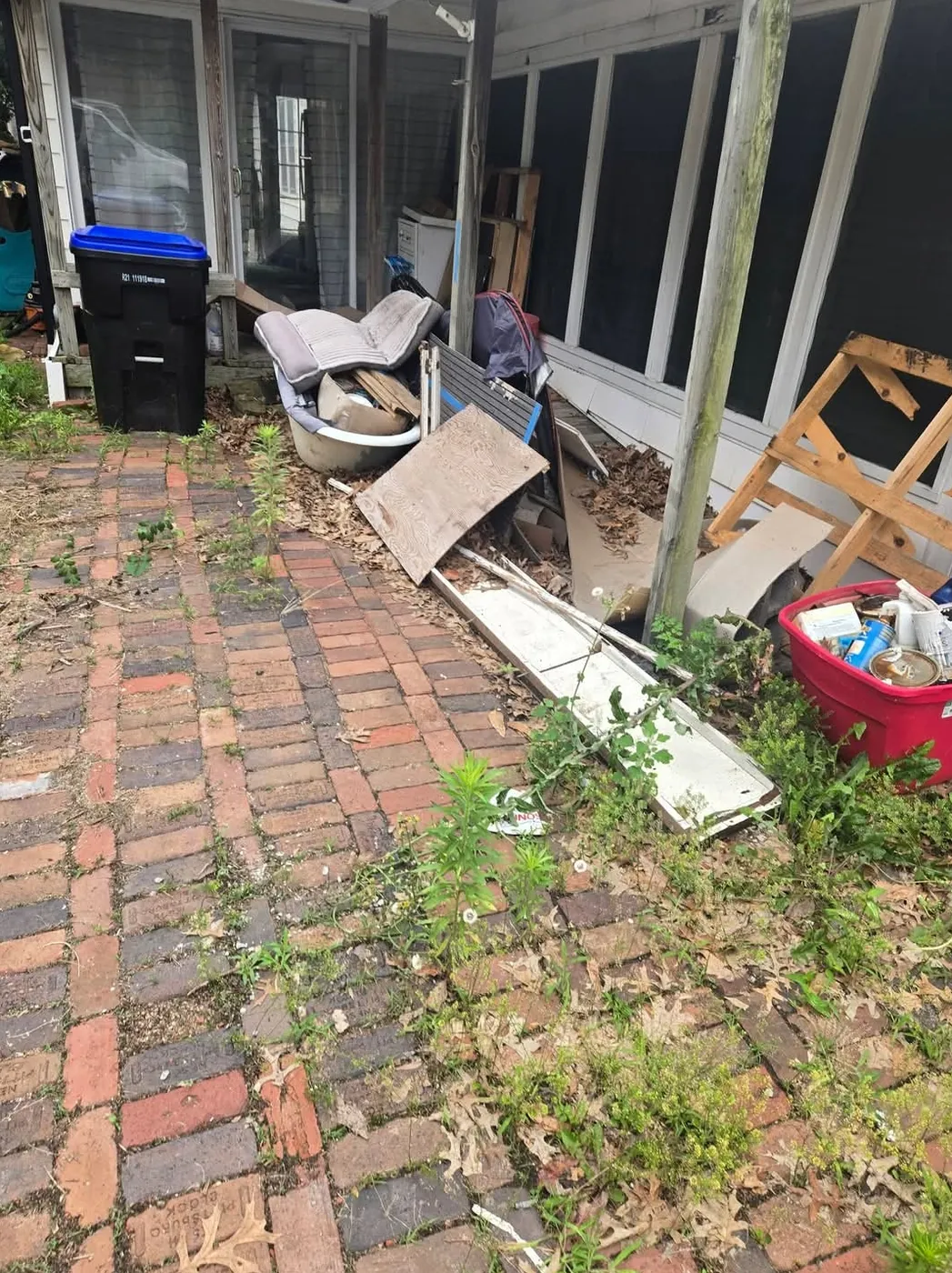
Nationally, an estate cleanout averages about $1,250, and most people pay somewhere between $275 and $4,000, according to Angi’s and HomeAdvisor’s cost data. That range is so wide it is almost useless on its own. Where you land inside it comes down to three things: how much is actually in the house, how hard it is to carry out, and how much of it has to be paid to go away. The third one is the only part that changes meaningfully by town, and in Shawnee County it changes in your favor more than most people realize.
I do clean outs in Topeka for a living, mostly for families settling an estate, landlords turning a unit over, and people getting a parent’s house ready to list. Here is how the number is actually built, and the local parts that no national calculator knows about.
The short answer, by size of house
These are national figures, published by College HUNKS, and they are a reasonable starting shape for Topeka. Treat them as a band, not a quote.
| What you’re clearing | National range | What usually decides it |
|---|---|---|
| A single room or a small apartment | $275 to $800 | Whether anything heavy has to come down stairs |
| A three bedroom house | $1,000 to $2,500 | The basement and the garage, almost every time |
| A large house, five or more bedrooms | $2,500 to $6,000 and up | Volume, plus how much has to be sorted rather than hauled |
Labor is commonly quoted at $25 to $50 an hour per worker. If somebody gives you a number far under these bands for a whole house, ask what happens to the contents, because the answer is usually that disposal is billed separately afterward.
What actually drives the number
Five things, roughly in the order they matter:
- Volume. Not square footage. A tidy four bedroom house can be cheaper than a two bedroom with a packed basement. Nobody prices an estate cleanout per square foot, and anyone who offers to has not looked in the garage.
- Access. A full basement with a narrow staircase, a second floor, a detached garage at the back of a lot. Angi puts the stair surcharge at roughly $40 to $100 per staircase. In Topeka this matters more than it would in a newer market, because so much of the older housing stock here has a full basement and the stairs to match.
- Sorting versus hauling. If everything goes, it is a hauling job. If somebody has to open every drawer because the deed and the insurance policy are in one of them, it is a slower job and it is priced like one. Angi lists sorting paperwork at $50 to $500.
- The awkward items. A piano runs about $400 to deal with. A refrigerator is $50 to $150 because of the refrigerant. Electronics and chemicals are listed nationally at $50 to $500, which is a line you can mostly delete in Shawnee County. More on that below.
- Weight. The landfill charges by what the scale says, not by how full the trailer looks. A basement of books and a garage of old upholstery can take the same space and cost very different money to dump.
The two Topeka numbers the national guides don’t have
Every cost guide on page one of Google quotes that $1,250 average and then lists the same per-item prices. Not one of them knows what your local landfill charges or what your county will take off your curb for nothing. Those two facts are most of the gap between the bottom and the top of their own range.
One large item a week, free, if you start early
Shawnee County Solid Waste residential service is $22 a month in the city and $23 rural, and that rate includes one bulky item per week put out with your regular trash, plus up to 15 bags of yard waste. A couch. A mattress. A box spring. A recliner.
Compare that with the national figure for having a piece of furniture or a mattress taken away, which Angi and HomeAdvisor both put at roughly $180 an item. If the house still has active trash service and you start six weeks before the closing or the listing, that is six large items gone at no cost. On a three bedroom house, that is a real bite out of a four figure quote, and it is the single most useful thing in this article.
The catch is that it is one item a week, it goes out on your normal trash day, and holiday weeks are skipped. It only works if somebody starts well before the truck is booked. Most families call a week before the walkthrough, which is exactly when this lever stops being available.
Paint, chemicals and electronics are a free problem here
The Shawnee County Household Hazardous Waste facility at 131 NE 46th Street takes paint, chemicals, batteries and most electronics from households, mostly at no charge. Garages and basements in estates are full of this: half cans of paint, old thinner, a shelf of lawn chemicals, a dead CRT television. Nationally that is a $50 to $500 line item on your quote. Here it is a trip and a conversation.
Everything else goes to the scale
The rest ends up at Rolling Meadows Landfill on NW Highway 75, where the charge is based on weight and material. WM does not publish a residential rate card online, so anyone quoting you a precise per ton figure for Topeka without calling is guessing. If you want the full map of where each category goes, I wrote it all out in the Topeka dump guide, including hours, tires, appliances and donations.
An estate cleanout is not the same job as junk removal
This trips people up when they compare quotes. Straight junk removal is priced on volume: you point, it leaves. An estate cleanout carries work that junk removal does not.
- Somebody has to decide what stays, and often that somebody is three siblings who are not in the same state.
- Documents, photographs, jewelry and cash turn up in furniture. They turn up in the lining of a recliner and taped under a drawer. A crew that is being paid to move fast is the wrong crew for that.
- Donations have to be separated and delivered, not just set aside.
- Anything being sold has to survive the process. Estate sale companies commonly take 35 to 40 percent of gross proceeds, so what is worth selling and what is worth donating is a real decision, not an afterthought.
- The house usually needs to be broom clean and presentable at the end, because a listing or a final walkthrough is waiting on it.
If a quote looks low, check which of those are in it. If a quote looks high and all of them are in it, it may be the right number.
A sequence that actually saves money
The order you do this in changes the bill more than who you hire does.
- Before anything leaves, walk the house with whoever has a claim on the contents and take photos. This prevents the phone call three weeks later about the dresser.
- Find the paperwork first. Deeds, titles, policies, tax records, the safe deposit key. Do this while the house is still full, not while a crew is carrying boxes past you.
- Confirm the trash service is still active and in whose name. If it has been cancelled after a death, restarting it may be worth more than it costs.
- Start the weekly bulky item pickups immediately. One a week, every week, from today until the house is empty.
- Make one trip to the hazardous waste facility with the paint, chemicals, batteries and electronics.
- Deal with anything being sold or donated next, while there is still room to move around it.
- Get a quote on what is left. That is the only number you actually have to pay somebody for, and it is a much smaller number than the one you would have gotten in week one.
What you can do yourself, honestly
Plenty of it. The sorting, the paperwork, the donations and the weekly curb pickups are all things a family can do, and doing them is where nearly all of the savings are. If you have a pickup, a free Saturday and a short list, you may not need anybody.
Where people underestimate it is the back half. The last 20 percent of a house is appliances, a mattress nobody wants to touch, the chest freezer in the basement, the shed, and whatever is behind the shed. That part is heavy, it does not fit in a car, and it is usually under a deadline. It is also the part where somebody gets hurt on a basement staircase.
It is worth a call when there is a closing date, when the volume is beyond what weekly pickups will clear in time, when there are stairs and heavy items in the same sentence, when the house also needs small repairs before it is shown, or when nobody in the family lives close enough to spend four weekends on it. That last one is most of my clean out calls.
Landlords, the same math applies at turnover, and the weekly pickup is just as useful between tenants. That work sits with ordinary rental property repairs, and the patching, painting and fixture swaps a unit needs afterward are the same visit. For an owner-occupied house getting ready to list, the punch list usually falls under home repairs.
Five questions before you accept a quote
- Is disposal included, or billed after? This is the single most common surprise on a cleanout invoice.
- Who is doing the sorting, and what happens if they find something valuable? Get the answer before anyone starts.
- Is the quote for the whole house or what you can see? Attics, crawl spaces and sheds have ended more than one fixed price.
- Is it broom clean at the end? If a realtor is walking it on Monday, say so.
- Are they insured? People are carrying heavy things down stairs in somebody else’s house.
Common questions
- How much does it cost to clean out a house?
- Nationally the average is about $1,250, with most jobs falling between $275 and $4,000 according to Angi and HomeAdvisor. A single room or small apartment typically runs $275 to $800, a three bedroom house $1,000 to $2,500, and a large house $2,500 to $6,000 or more. Volume and access drive it far more than square footage does.
- Is an estate cleanout cheaper than junk removal?
- Usually it is more expensive for the same volume, because it is a different job. Junk removal is priced on how much leaves. An estate cleanout includes sorting, finding documents and valuables, separating donations and leaving the house presentable. If an estate quote and a junk removal quote look the same, check which of those the cheaper one actually includes.
- Can I get rid of furniture for free in Topeka?
- If the house has Shawnee County Solid Waste residential service, yes, one large item a week. A couch, a recliner or a mattress and box spring goes out with your regular trash on your normal trash day, included in the monthly rate, with holiday weeks skipped. Nationally, having a single piece of furniture hauled runs around $180, so starting these pickups weeks before your deadline is the cheapest move available to you.
- Who pays for an estate cleanout?
- Normally the estate does, as an expense of settling it, which means it generally comes out of the proceeds rather than out of an individual’s pocket. How that works in your situation depends on the will, the executor’s authority and what the probate court requires, so confirm it with the attorney handling the estate before committing to a large job. I am a handyman, not a lawyer.
- How long does it take to clean out a house?
- The hauling itself is usually one to three days for an average Topeka house once decisions have been made. The sorting is what takes weeks, and it is the part families consistently underestimate. If you have a closing date, count backwards from it and start the weekly curbside pickups the day you know the date.
- What do I do with old paint and chemicals from the house?
- Take them to the Shawnee County Household Hazardous Waste facility at 131 NE 46th Street, which accepts paint, chemicals, batteries and most electronics from households, mostly free. They do not go in the trash cart and the landfill does not take them. Nationally this category is quoted at $50 to $500 on a cleanout, so handling it yourself is worth the trip.
Clearing a house in Topeka?
Text a few photos to (785) 408-6846: one of each room that still has to be dealt with, plus the basement and the garage. You’ll get an honest number back, usually the same day, and an estimate costs nothing. If the free weekly pickups will clear most of it before your deadline, I’ll tell you that too. I work anywhere in Topeka, seven days a week, I’m fully insured, and the floor gets swept before I leave. If it is one room rather than a house, that is ordinary handyman work and the same number applies.