
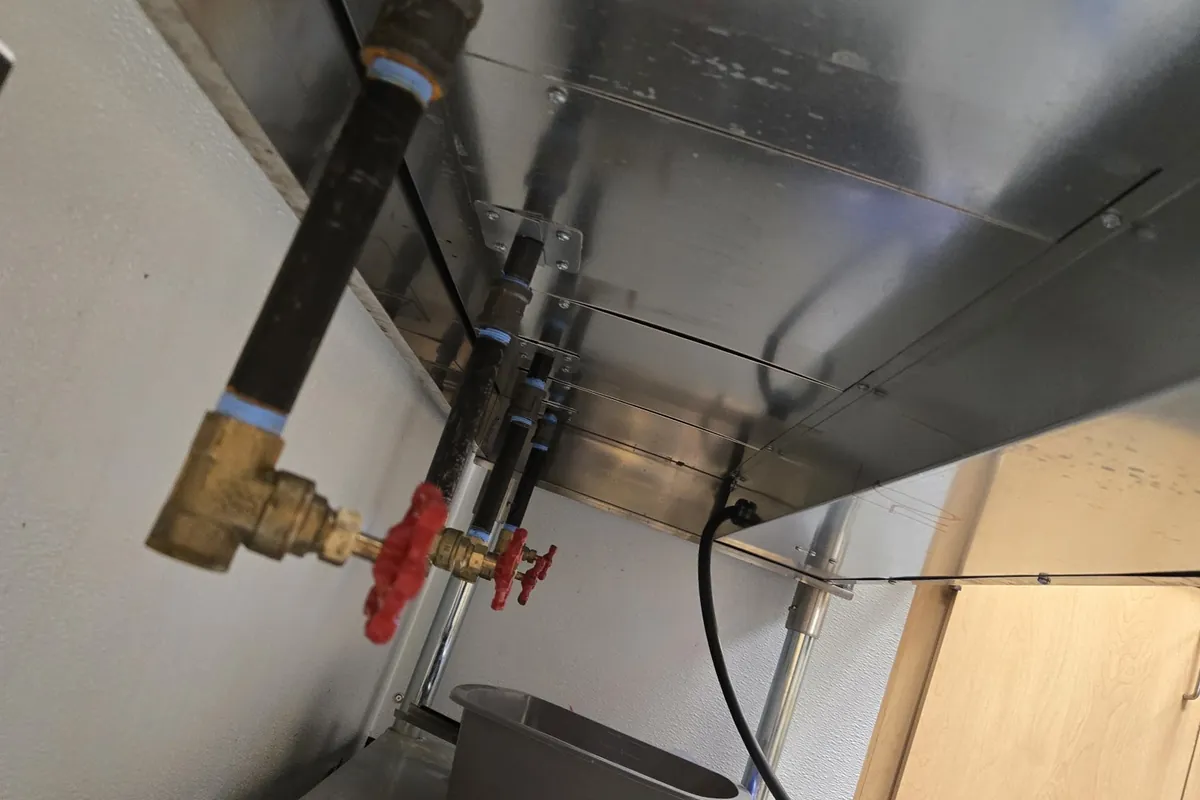
Two things decide how you winterize an outdoor faucet, and most guides never tell you to check either one: which of the two kinds of spigot is on your house, and whether there is a shutoff valve for it inside. Get those right and the job takes fifteen minutes with no tools. Get them wrong and you can follow every step you read online and still split a pipe inside the wall. Here is how to tell the two apart, what each one actually needs, and what to do when there is no shutoff valve to close.
Plumbing fixture work is a good chunk of what I do around Topeka, and this is one of the cheapest fifteen minutes a homeowner can spend. The timing matters too: NOAA’s 1991–2020 normals put Topeka’s first 32-degree night in the back half of October. Mid-October is the weekend to do this, not December.
First: which kind of faucet do you have?
Every outdoor faucet is one of two designs, and they need opposite treatment. Nearly every bad winterizing job I have seen comes from doing the standard-faucet routine on a frost-free one, or the other way around.
A standard hose bib holds its shutoff right where you see it, at the wall. When the handle is closed, there is still water sitting in the faucet body and in the pipe behind it, on the cold side of the wall. That water is what freezes and splits the pipe.
A frost-free sillcock looks similar from outside but is a much longer fixture. Its actual shutoff sits six to twelve inches back, inside the heated wall, and the long barrel between there and the outside is meant to drain itself by gravity every time you shut it off. That only works if the fixture was installed with a slight downward pitch toward the outside, and only if nothing is attached to the end.
| Standard hose bib | Frost-free sillcock | |
|---|---|---|
| What it looks like | Short and squat. Body sticks out two or three inches, handle sits close to the siding. | Longer and slimmer. Often a small domed cap (a vacuum breaker) on top. |
| The running test | Water stops the instant you close the handle. | Water keeps running two to ten seconds after you close it, then stops. That is the barrel draining. |
| Needs a shutoff valve inside | Yes. This is the whole job. | Usually no, if it drains properly. |
| Over the winter, leave it | Open | Closed |
| Hose left attached | Bad | Worse. It stops the barrel draining and defeats the design. |
The running test is the reliable one. Turn the faucet on, then shut it off and listen. An instant stop means standard. A couple of seconds of trailing flow means frost-free and means it is draining the way it should.
Winterizing a standard hose bib
- Take the hose off. Also splitters, timers, quick-connects and filters. Drain the hose by walking it hand over hand from one end, coil it loosely and put it in the garage or shed. A hose left attached holds a column of water right against the faucet and will freeze it even if you did everything else right.
- Find the shutoff valve inside. Look on the interior wall directly behind the faucet, usually in the basement, crawl space, utility room or garage ceiling. You are looking for a small valve on a branch line heading toward that outside wall. It will have either a round multi-turn handle or a lever.
- Close it. Round handle, turn clockwise until it stops. Lever, a quarter turn so the lever sits across the pipe instead of along it.
- Go back outside and open the faucet all the way. Water should run for a moment and then stop to a drip. If it keeps running steadily, you closed the wrong valve. Go find the right one.
- Bleed the line. Many of these shutoff valves have a small cap or screw on the side, called a bleeder. With the outside faucet open, put a cup under the bleeder and open it. A little water comes out, which is the water you are trying to get rid of. Close the bleeder when it stops.
- Leave the outside faucet open all winter. Not cracked, open.
Then go walk the property. The faucet by the back patio is the one people protect. The one on the detached garage, the one behind the shrub on the north side, and the one in the crawl space feeding a utility sink are the ones that burst.
Winterizing a frost-free sillcock
Shorter list, because the fixture does the work.
- Take the hose and every attachment off. This is not optional on a frost-free faucet. The barrel cannot drain with a hose on the end, and a frost-free sillcock that cannot drain is just a standard faucet with the freeze point moved deeper into your wall.
- Open it, let it run a few seconds, shut it off, and confirm you get that trailing drain.
- Leave it closed.
- Check for drips at the handle over the next few days. A frost-free faucet that weeps after being shut off has a worn stem washer, and that slow leak will sit in the barrel and freeze.
What if there is no shutoff valve inside?
This is the situation most guides skip with a line about calling someone, and it is extremely common. You have a few honest options.
Confirm what you are dealing with first. Run the test above. If the faucet is frost-free and drains properly, the missing shutoff is not a problem. Frost-free fixtures are often installed without one on purpose.
If it is a standard hose bib with no interior valve, you cannot fully winterize it, and no amount of foam will change that. An insulated cover plus a disconnected hose will get a standard faucet through an ordinary Topeka cold snap. It will not reliably get it through a stretch of days that stay below freezing. The real fix is adding a shutoff valve on the branch line inside, or swapping the fixture for a frost-free sillcock. Either is an afternoon, and both are a lot cheaper in October than a wall repair in January.
If the valve is there but will not turn, stop. Old gate valves seize, and the two ways they fail are that the stem packing lets go, or the gate snaps off the stem inside the body. Both of those turn a closed valve into an open leak you cannot shut off without killing water to the whole house. Penetrating oil and gentle pressure, once. If it does not move, leave it and get it replaced instead of forcing it.
For a vacant house or a rental between tenants, the cleanest answer is shutting off the main and draining the system down rather than chasing individual fixtures. If you are turning a unit over this fall, I handle that as part of rental property repairs.
Open or closed for the winter? Both answers are out there
Search this and you will find one page telling you to leave the outside faucet open and the next telling you to shut it. Both are right, for different faucets, and nobody says which is which.
Standard hose bib: leave it open. Once the interior valve is closed and bled, an open faucet gives any leftover water somewhere to expand instead of pushing against a closed valve and a pipe wall, and it lets the body dry out.
Frost-free sillcock: leave it closed. Its seal is at the warm inside end. Closing it is what puts the barrel in its drained state in the first place. Leaving it open holds the whole length open to the water line and gains you nothing.
Covers, heat tape and dripping: what actually helps
Foam covers are five dollars and worth having, but they are the last layer, not the plan. A cover slows heat loss from a faucet body. It does not remove water, and it cannot keep a water-filled standard hose bib above freezing through a Kansas cold snap that sits in the teens for three days. Drain first, cover second.
Heat tape is for pipe runs that genuinely cannot be drained, such as an exposed line in an unheated crawl space. It needs a working outlet and it needs to be the kind rated for water pipe and installed per the instructions. It is not a substitute for closing a valve.
Dripping is good advice aimed at the wrong fixture. Letting a tap drip during a hard freeze is for indoor plumbing on exterior walls, where you want movement in a line you cannot drain. An outdoor faucet you have already drained has no water in it to move, and dripping a standard outdoor faucet that is still charged with water just keeps water sitting in the worst possible spot. Drain it instead.
When Topeka actually freezes
Working from NOAA’s 1991–2020 climate normals for the Topeka station, there is roughly a 30 percent chance of a first 32-degree night by October 17, and it is a coin flip by about October 22. The first hard freeze, 28 degrees, lands near the end of the month, with even odds by about October 31.
Those are averages, and the tails are long. The National Weather Service office in Topeka lists the earliest first freeze on record as September 22, 1995, and the latest as November 21, 1944. That spread is the argument for doing this in the middle of October rather than waiting for a forecast to scare you into it. The night the first freeze warning goes up is the night everybody is outside with a flashlight looking for a valve they have never found before.
If it is already frozen
Signs: no water at the spigot when the handle is open, or a faucet in the house on that same line running at a trickle. Before you thaw anything, find the shutoff and be ready to close it, because a cracked pipe does not leak while it is frozen. It leaks the moment it thaws, and the ice is the only thing plugging the hole.
- Open the faucet first, so melting water has somewhere to go and you can see progress.
- Thaw gently. A hair dryer, a heat gun on low, warm wet towels, or a space heater pointed at the area from a safe distance.
- No torch, no open flame, ever. That is how pipe thawing becomes a house fire, and it will scorch the framing behind the siding whether or not anything catches.
- Work from the faucet back toward the house, not the other way, so meltwater can escape instead of building pressure behind the ice.
- Watch it as it opens up. If water comes out anywhere it should not, close that shutoff.
When it is a call, not a chore
Most of this is genuinely a homeowner job, and I would rather you do it yourself than pay me to turn a valve. Call someone when the shutoff valve is seized or missing, when the spigot drips after it is shut off, when the faucet body wobbles against the siding, or when you want a frost-free sillcock put in before the cold sets in.
That is plumbing fixture repair work: replacing a hose bib, adding or swapping a shutoff valve, rebuilding a frost-free stem. It is the same bench of skills as a faucet replacement inside, just colder. Same visit, I can knock out the rest of the list on the fridge, which is usually how these go. If the damage is already done and there is a split line inside a wall or under the slab, that is a licensed plumber’s job and I will tell you so rather than open your drywall to find out.
Common questions
- Should I leave my outside faucet open or closed in the winter?
- It depends which kind you have. A standard hose bib should be left open once you have closed and bled the shutoff valve inside, so leftover water has room to expand. A frost-free sillcock should be left closed, because its seal sits at the warm inside end and closing it is what lets the barrel drain. This is why you see both answers online.
- How do I winterize an outdoor faucet with no shutoff valve?
- First check whether it is frost-free by shutting it off and listening for two to ten seconds of trailing drainage. If it is, the missing valve is fine by design. If it is a standard hose bib with no interior valve, you cannot fully winterize it. Disconnect the hose and fit an insulated cover as a stopgap, then have a shutoff valve added or the fixture swapped for a frost-free one.
- Should I let my outside faucet drip in freezing weather?
- No. Dripping is advice for indoor pipes running through exterior walls, where you cannot drain the line and want water moving. An outdoor faucet should be drained instead, which leaves nothing in it to freeze. Dripping a standard outdoor faucet that still has water to it keeps water sitting in the most exposed part of the system.
- At what temperature do outdoor faucets freeze?
- Water freezes at 32 degrees, but a brief dip to 32 rarely causes damage. The risk comes from how long it stays below freezing and how exposed the fixture is. A night in the mid-twenties on a shaded north wall, or two or three days that never climb above freezing, is the kind of stretch that splits a water-filled hose bib or the pipe behind it.
- Do I need to cover my outdoor faucet if it is frost-free?
- Usually not, if the hose is off and it drains properly when you shut it off. A cover does no harm and is cheap insurance on an exposed wall or before an unusually hard freeze. What matters far more on a frost-free sillcock is that nothing is attached to the end, because a hose stops the barrel draining and cancels out the design.
- How do I know if my outside faucet is frozen?
- Open the handle. No water, or a weak trickle that dies, means ice in the line. A fixture inside the house on that same branch running slowly is another sign. Find your shutoff valve before you thaw it, because a cracked pipe stays sealed by the ice and only starts leaking once it thaws.
One call before the cold
If you walked outside, found a valve that will not budge or no valve at all, and you would rather not guess, text a photo of the spigot and the pipe behind it to (785) 408-6846. You will get a straight answer back about which kind you have and what it needs, usually the same day. I work anywhere in Topeka, seven days a week, and I am fully insured. It is a short job in October and an expensive one in January.